Price tells you where the market went. The heatmap tells you what it had to get through: every resting limit order, coloured by size, scrolling left as time passes, with the aggressive prints that hit them drawn on top.
Each read is a stated rule rather than a threshold tuned by feel, so what fires is checkable. On Elite they are drawn on the chart where they happened, named in the flow panel beside it, and matched by your alert rules.
block · sweep · liq
Somebody arrived
A print past a running mean plus k standard deviations, calibrated per instrument by Welford update, so large means large for that instrument, on BTC or a thin altcoin. A sweep takes four or more price rows on one side inside a single slice, and a liquidation is a position the exchange closed for its owner.
absorb · refill · eaten · pulled
A wall answered
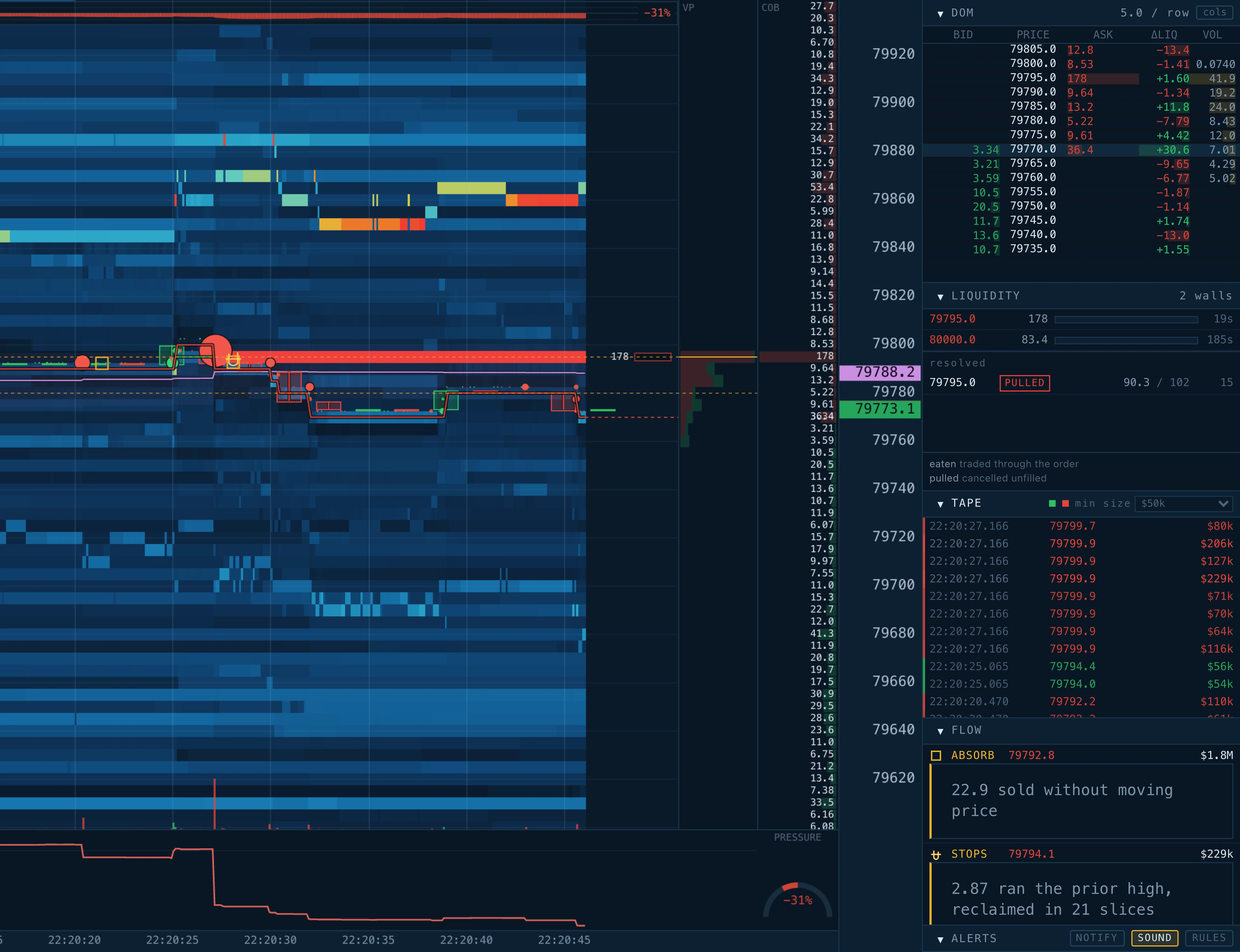
Absorption is sustained one sided aggression while the touch refuses to move. A refill is more volume traded at a price than was ever displayed there, which is an iceberg. And when a wall goes, the book and the prints between them say which way: eaten by the tape, or pulled before it was hit.
stops · spoof?
Not what it looked like
A stop run is a prior high or low broken on a burst that price then comes straight back through. A break that holds was a breakout, and nothing fires. A spoof candidate is a wall the market reached that vanished untraded. Both report the shape of an event, never anybody's intent.
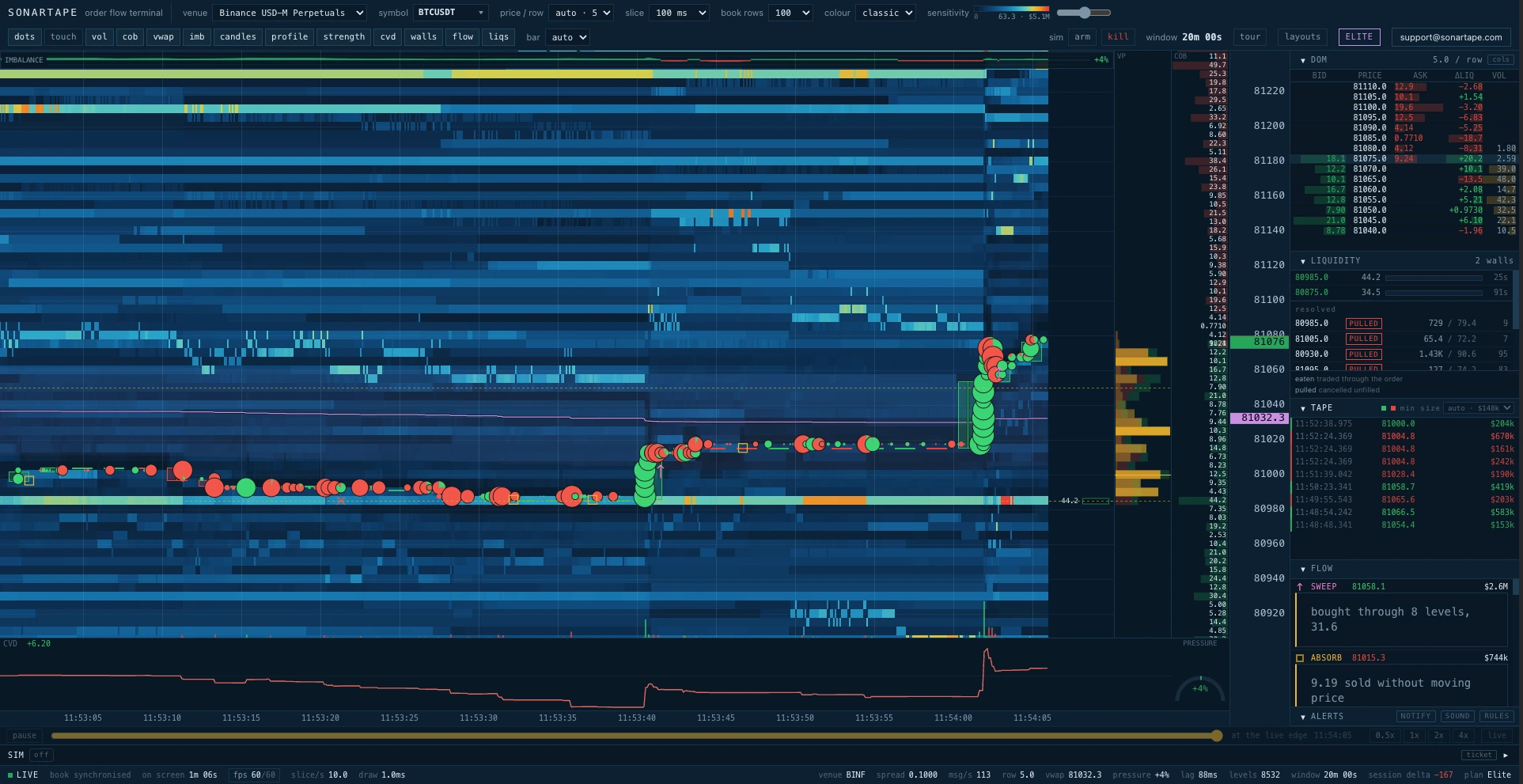
The reads firing live: a sweep bought through eight levels and an absorption sold without moving price, each drawn where it happened and named in the panel beside the ladder.
Four layers, one grid.
The chart is a time by price grid. Each column is one sample of the whole book, each row is a band of price, and three more layers are drawn over the top of it.
layer one
Resting liquidity
Every limit order sitting in the book, summed into its price row and coloured against a rolling upper quantile of what is currently resting. Ordinary depth stays a dark field, so a wall reads as a bright horizontal bar and its disappearance is just as visible.
layer two
Aggressive prints
Every fill, placed at the price it happened and sized by value, green when the buyer crossed the spread and red when the seller did. The side comes from the exchange wherever it states one reliably, and from the print against the live touch where it does not.
layer three
The indicators
Best bid and offer, the live book down the right edge, candles, VWAP, traded volume, book imbalance, volume profile, cumulative delta and level strength. Each one is a toggle, because a chart with everything on is a chart nobody can read.
layer four
The reads
Walls marked where they rest, with a gauge that fills as the tape eats into them, every read from above at the price and moment it fired, and liquidations as bursts pointing the way they pushed price. This layer is Elite.
All four layers at once: resting size in colour, prints on top, the indicators over them, and a wall, an absorption and a stop run marked where they happened, beside the ladder and panels that read them back.
Every major exchange, yours included.
A liquidity heatmap needs full depth many times per second and prints that carry the aggressor side. For crypto both are free and public: no key, no quota, no per-user permission. Your terminal subscribes through our relay, which holds one upstream connection per market and records none of what passes through it. Binance and Bitget refuse datacenter traffic, so their feeds open from your own connection instead.
A ladder, a tape, and a profile that agree with the chart.
Depth of market
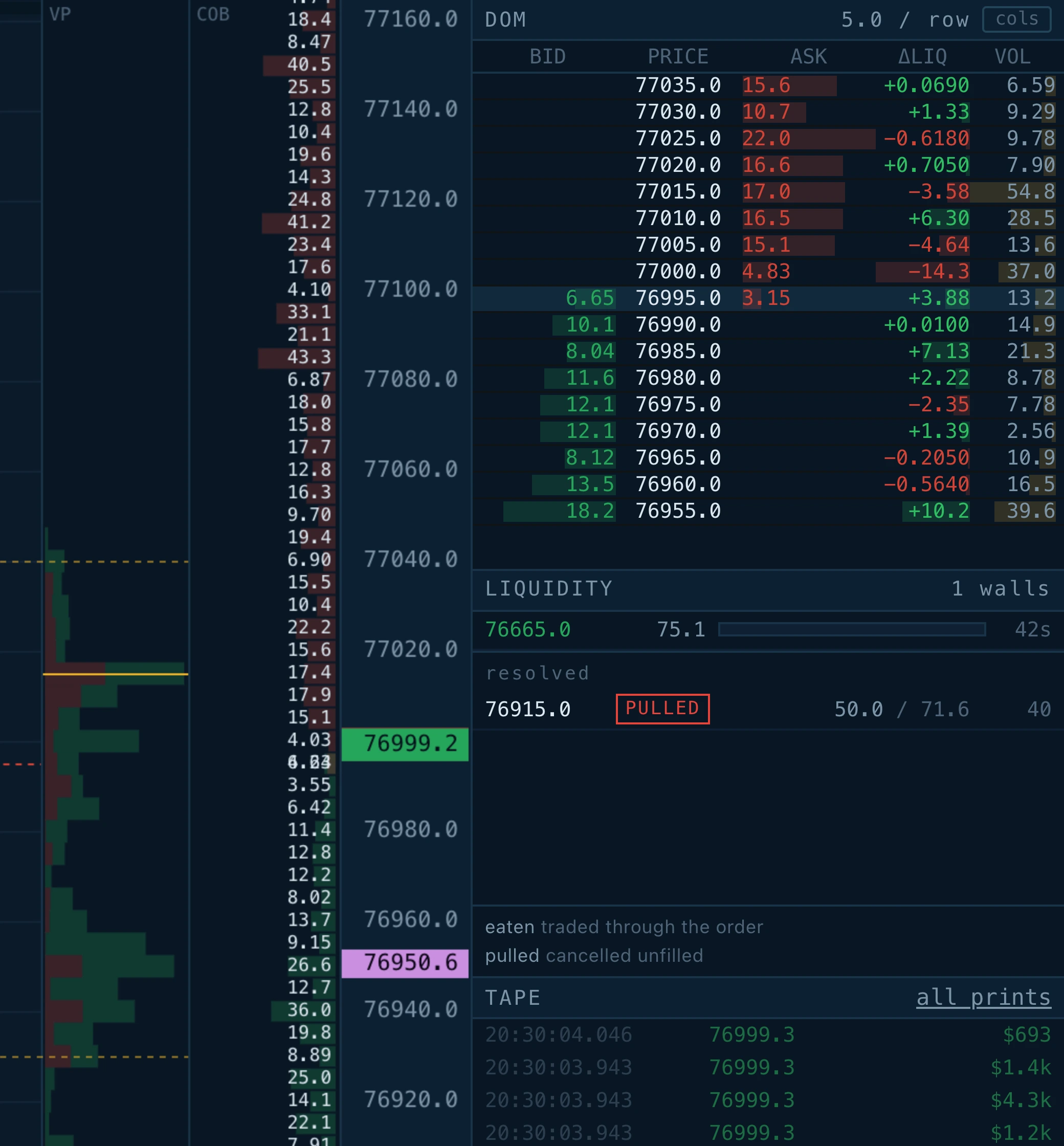
The ladder is rebuilt from the same grid cells the chart is drawing, so it is the book as the chart understands it rather than a second, slightly different opinion. Bars scale to the largest row on screen, and traded volume per level sits beside resting size.
Tape priced in dollars
Exchanges that publish every fill separately produce a tape of four decimal quantities with no sense of scale. Every print and every alert here is measured in quote currency, and the floor can follow what has actually been printing on the instrument.
Profile and delta
Volume profile down the side and cumulative delta underneath, both computed from the same prints the tape is listing, so the three of them cannot disagree about what traded.
Ladder, walls, tape and flow, stacked in one column beside the chart.
The tools for professionals.
The chart above is a demo. Same engine, read only, on symbols we pin. Free is the real terminal on BTC and ETH — live, no card, no expiry. Pro puts it on every exchange at 50 ms with the full depth band, and starts with 7 free days. Elite adds the detection suite, the alert rules that fire on it, and twice the retained window.
yearly saves 2 months
Free
no card
The real terminal on BTC and ETH, live and without a card. Coarse, shallow, and enough to see what it does.
Freefor as long as you like
Included
Real time exchange coverageBTC and ETH, 2 exchanges
Retained slices600 columns
Fastest slice interval500 ms
Depth tracked per side120 rows
Replay of the retained windowyes
An account, no card, and no expiry. Upgrade whenever the limits start to bite.
Pro
7-day free trial
The market as it happens: every exchange, full depth, 50 ms slices, the ladder, the tape and replay.
$29.90per month, billed monthly
Beyond free
Retained window at 50 ms5m
Volume profile and cumulative deltayes
Saved workspaces50
Real time exchange coverageall 33 markets, live
Retained slices6,000 columns
Fastest slice interval50 ms
Depth tracked per side2,000 rows
Cancel any time in the billing portal. Nothing is charged for 7 days.
Elite
the whole product
Everything in Pro, plus the flow layer that reads the book for you.
$59.90per month, billed monthly
Everything in Pro, and then:
The detection suite
Block, sweep, absorption and refill detectionyes
Walls, stop runs and spoof candidatesyes
LiquidationsBinance · Bybit · OKX · BitMEX
Alert rulesyes
A longer memory
Retained slices12,000 columns
Retained window at 50 ms10m
Billed from day one, and Pro subscribers move up in the portal.
This build has no account provider configured, so checkout is disabled and the terminal runs in local mode. Set a Clerk publishable key to enable accounts.
Hear it from us.
An occasional note when the terminal gains something worth learning, and when the market does something it was built to read. No schedule, nothing to buy, and no address traded on to anybody.